Linking Multiple Perspectives with Object-Based Visual Cues for Spatial Video Analysis
Abstract
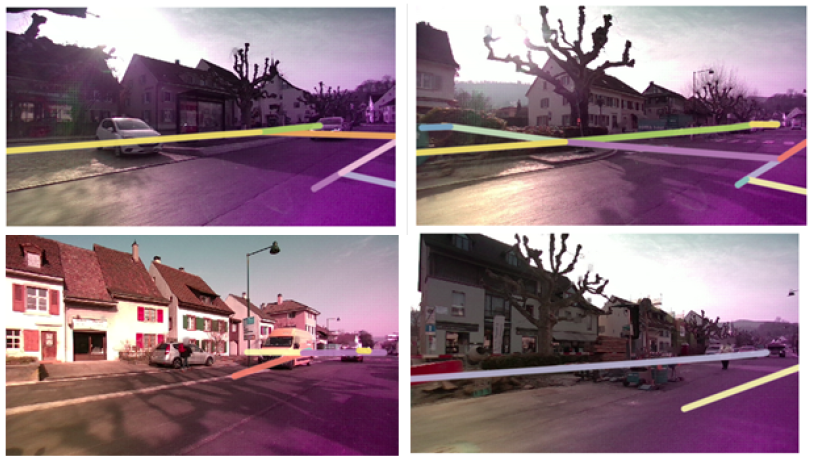
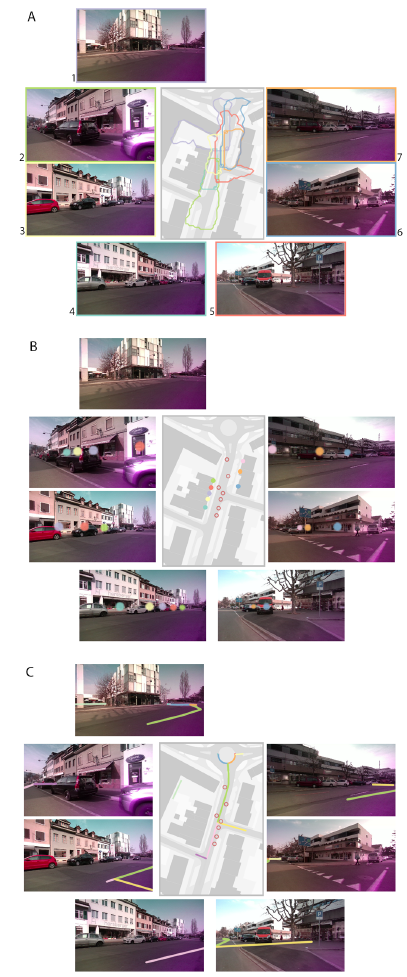
The visual analysis of videos in context with mapped information requires support in the challenges of linking different spatial perspectives (e.g., street level and survey perspective), bridging different levels of detail, and relating objects in different visual representation. Uncertainty in the spatial relation between camera views and map complicates these tasks. We implemented visualizations for the visual analysis of street level videos (i.e., video key frames) embedded in their spatial context. As part of this, we developed a design rationale for visual cues that help link the video key frames and a map in cases where the spatial relation between camera view and map is of uncertain accuracy. We implemented three cue types (simplified viewshed, object-based dot cues, street centre line cues) for an image data set with heterogeneous camera localization accuracy and assessed the resulting cue properties. Based on this, we argue in favour of cue designs that minimize uncertain information required for their display at the expense of cues’ spatial explicitness in cases of potentially low camera localization accuracy. When localization accuracy is expected to be at least moderate, particularly, dot cues that refer to unambiguous points of reference within easily recognizable objects of ample size present a promising option to support view co-registration.
Figures
BibTeX
@article{hollenstein_linkingPerspectives4spatialVideoAnalysis_2022,
 abstract = {The visual analysis of videos in context with mapped information requires support in the challenges of linking different spatial perspectives (e.g., street level and survey perspective), bridging different levels of detail, and relating objects in different visual representation. Uncertainty in the spatial relation between camera views and map complicates these tasks. We implemented visualizations for the visual analysis of street level videos (i.e., video key frames) embedded in their spatial context. As part of this, we developed a design rationale for visual cues that help link the video key frames and a map in cases where the spatial relation between camera view and map is of uncertain accuracy. We implemented three cue types (simplified viewshed, object-based dot cues, street centre line cues) for an image data set with heterogeneous camera localization accuracy and assessed the resulting cue properties. Based on this, we argue in favour of cue designs that minimize uncertain information required for their display at the expense of cues’ spatial explicitness in cases of potentially low camera localization accuracy. When localization accuracy is expected to be at least moderate, particularly, dot cues that refer to unambiguous points of reference within easily recognizable objects of ample size present a promising option to support view co-registration.},
 author = {Hollenstein, Daria and Bleisch, Susanne},
 doi = {10.5194/isprs-archives-XLIII-B4-2022-455-2022},
 journal = {The International Archives of the Photogrammetry, Remote Sensing and Spatial Information Sciences},
 pages = {455--462},
 title = {{Linking} {Multiple} {Perspectives} {with} {Object}-{Based} {Visual} {Cues} {for} {Spatial} {Video} {Analysis}},
 url = {https://isprs-archives.copernicus.org/articles/XLIII-B4-2022/455/2022/},
 volume = {XLIII-B4-2022},
 year = {2022}
}